
The first wetland Julie Mulonga ever loved was the one that vanished. As a girl in Kenya, she would stand by the edge of a once-clear stream, watching it turn brown and sluggish, choked with pollution. What had been a place alive with frogs and reeds became lifeless water.
Now Director of Wetlands International in Eastern Africa, Julie leads teams across four countries to safeguard wetlands. Her office spans landscapes as different as the mangroves of the Eastern Africa coast and the lakes of the Great Rift Valley, yet she speaks of them as one connected system—where people and biodiversity breathe the same air, drink the same water and share the same fate.
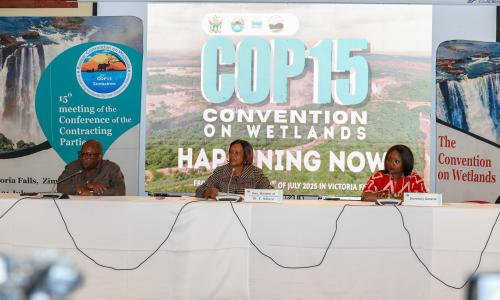
In 2025, her leadership and vision earned her recognition as one of the Women Changemakers in the World of Wetlands, an initiative of the Ramsar Convention on Wetlands honouring twelve women transforming conservation worldwide. She was celebrated during the Convention’s COP15 in Victoria Falls, Zimbabwe, where her work was recognized for bridging science, policy and community action across borders.
Her route into conservation began in academia. During her PhD on the climate vulnerability of mangrove-dependent communities in Kenya, she spent years in the field listening to local voices—fishers who had lost their catch to rising salinity, families watching the sea creep closer to their homes.
“Conservation,” Mulonga says, “is not just about protecting nature. It’s about supporting the communities that depend on it.”
That experience deepened her belief in combining research with real-world action. At Wetlands International, she found a network that shared her conviction that science, policy, and community engagement must work hand in hand. Her work has taken her from the freshwater wetlands in the Nile River Basin to the mangrove forests of Eastern, Western Africa and Indonesia, and from regional initiatives to global platforms like the UNFCCC and the Convention on Wetlands. Through each experience, she’s seen how wetlands defy political boundaries—and why efforts to save them must do the same.
Among the many places she’s worked, Abijatta-Shalla National Park in Ethiopia remains closest to her heart. Once a haven for flamingos and waterbirds, it has suffered from water extraction, deforestation and pollution. Yet conservation efforts are gradually reversing the damage. Local communities are restoring habitats and governments are adjusting water use. The results show that new livelihoods are emerging.
“People are starting to see wetlands differently,” insists Mulonga. “They’re realizing they’re not wastelands, but sources of life.”
Inspiration, for Mulonga, comes not just from ecosystems but from people. She often recalls the late Wangari Maathai, whose Green Belt Movement turned tree planting into a symbol of empowerment, and Elizabeth Wathuti, a young Kenyan leader whose voice has amplified environmental justice on the global stage.
Mulonga’s dedication extends to championing other women in conservation. She advocates for mentorship, funding, and policy reform that make women visible and influential at every level of decision-making.
“When women have access to resources,” says Mulonga, “they create solutions that restore ecosystems and strengthen communities.” For her, empowerment isn’t a side goal—it’s central to conservation itself.
Mulonga also envisions new spaces for collaboration: technology hubs and cross-border platforms where women conservationists can share knowledge, conduct joint research and use tools like Global Mangrove Watch to monitor change in real time.
“By investing in women,” she says, “we ensure they are not just participants, but the ones leading the way.”
She still remembers the silence of that dying wetland from her childhood—the absence of birdsong, the stillness where there should have been life. That memory drives her work, though it no longer feels like loss. It feels like purpose.
“Wetlands are the lifeblood of our environment,” vows Mulonga. “They deserve every ounce of our passion and commitment.”