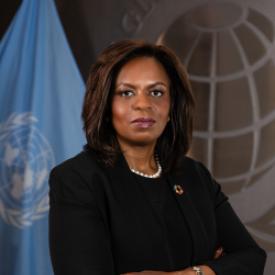

Africa Renewal’s Zipporah Musau spoke with Sanda Ojiambo, Assistant Secretary-General, and CEO of the United Nations Global Compact, about what to expect from this year’s gathering, where Africa’s biggest opportunities lie, and what it will take to scale businesses and create greater value on the continent:
More than 3,000 participants, including Heads of State, CEOs, investors, entrepreneurs, AU officials, UN officials and other decision-makers, are gathering in New York from 20 to 21 September for Unstoppable Africa 2026, the flagship event of the Global Africa Business Initiative (GABI). Held on the margins of the UN General Assembly, the event is organized by the UN Global Compact on behalf of the UN and AU, under the theme “Powering Business, Scaling Economies, Shaping the Future”.
Africa Renewal: Last year, Unstoppable Africa focused on Africa’s potential to shape global markets. This year’s theme is “Powering Business, Scaling Economies, Shaping the Future”. Can you give us three examples of how Africa is moving beyond simply supplying raw materials and talent to creating more value, innovation and investment on the continent?
Ms. Ojiambo: I like that you've highlighted the natural progression of the themes. Last year, when we talked about “The Big Push: Africa Shapes the Markets”, it was about echoing what was happening on the continent. The Pan-African voice was very strong, particularly around the importance of the African Continental Free Trade Area (AfCFTA).
We shaped this year's theme to demonstrate the natural progression from that to powering businesses, because businesses are the foundation. When businesses are empowered, we get into scaled economies, and that will continue to shape the future.
We have kept the same themes because we believe they are clear entry points for investment and where we can show results: energy, digital transformation, trade, creative industry and sports.
Could you give us some examples of how Africa is creating more value, innovation and investment on the continent?
One example is the construction of the Lobito Corridor [a railway project connecting the Democratic Republic of the Congo (DRC), Zambia and Angola’s port of Lobito], where a lot of work is going on to open that trade corridor. I was in Angola early this year. Lobito is one example of how building regional infrastructure can open up markets, allows for value addition, skilling, and it allows for investments in port infrastructure.
Another is digital infrastructure and AI. At last year's Unstoppable Africa, Strive Masiyiwa [a Zimbabwean billionaire businessman] announced a significant partnership with NVIDIA to develop AI infrastructure and data centres across the continent. At this year's event, we will report on the progress. It is about creating AI that works for Africa and by Africa, while allowing the continent to benefit from having this infrastructure on its own soil.
The third is the creative industries and sports. We all saw the African talent at the World Cup this year and we continue to play a leading role in fashion, sport, music and the arts on the global stage. The question is how we make sure there is more investment in the “back office” of that talent: management, investment plans, talent-building, training and infrastructure. Too often, that is still done by foreigners. We are not there yet, but we are working with governments and businesses to create that ownership. You can see the transition from simply being at the table to shaping the table: more ownership, more investment and being more in charge of the outcomes.
On the energy sector, we have “Mission 300” – a partnership of the World Bank and the Africa Development Bank and others, aimed at providing affordable electricity to 300 million people across Africa by 2030. So far it has mobilised more than $50 billion, with 32 countries preparing to sign national energy agreements.
How can we scale these gains?
Scaling is critical. Part of it is building confidence and showing that investment in Africa works. That is why Unstoppable Africa, and the work of the Global Africa Business Initiative (GABI) is so important to build confidence and show that investment in Africa works. Part of scaling is by shaping the narratives differently. When you see major investments in energy infrastructure, regional trade corridors, digital infrastructure and the AfCFTA, it demonstrates that Africa is investable.
The second is accessing affordable capital, including reform of the multilateral lending system. One of the biggest challenges to scale is access to affordable capital.
And the third is mobilizing domestic capital to invest in Africa's own growth.
Regional and continental cooperation is also essential. If you're building infrastructure, build bridges across economies and create pathways that allow for trade and job creation. Ultimately, the free movement of goods, services and people will be important to growing the continent.
Africa is rich in resources and talent, yet much of the value is still created elsewhere. What will it take to change this?
The resources and talent are there. The gap for me is that we probably haven't created enough of the “back office” to manage our resources and talent at scale.
Take the creative industries and sport. We have stellar sports people, but when they get to the global stage, they often have a foreign management company. Part of it is therefore being able to manage talent and create that infrastructure at home. We need to sponsor our own athletes and get private and public investment into athletes, creatives and others.
For commodities and tangible resources, it is about figuring out how we add value. That means building capacity for processing, skilling people so they can provide that value, opening up markets and moving economies from being purely production-based to manufacturing.
You need reliable energy to grow the manufacturing sector. And to grow markets and trade, you need infrastructure investment and the AfCFTA. There is a theme that runs through the work we do around the reliability of energy, trade, infrastructure and financing to grow Africa.
Where do you see the biggest opportunities for African businesses to grow and scale?
One is energy and critical minerals, simply because they are natural resources that are abundant on the continent, and there is a huge opportunity around value addition. The transitions that need to happen in energy and digital will be powered by the resources underneath our soil, but we need to be able to add that value and benefit from them in a way that is commensurate with the global value the world will get from them.
The second is digital and financial services. The continent is already, in many ways, moving far ahead with its unicorns and innovators. There is a lot of innovation that has sparked from the African continent. We need a lot more investment, including local investment in our unicorns and start-ups, but we also need to invest at scale and allow digital financial services to go at scale.
And then we have the creative industry and sports. They are huge GDP earners. The question is, how much of that GDP is exported? And are we able to build the infrastructure to enjoy the generation of GDP back in-country as well?

Access to affordable capital remains a major challenge, particularly for small and medium-sized enterprises (SMEs) and young entrepreneurs. How can we get more investment into African businesses and help them scale?
That's very true. We call it the “missing middle”. There are those that tend to be self-funded day to day, and then there are the large companies that are able to attract the financing they need. But most economies around the world, Africa not excluded, are powered by SMEs.
Digital financial services can really help. Platforms such as Mobile Money, including M-Pesa and others, help build up the creditworthiness of small entrepreneurs. You can generate a credit record through the work you do on mobile money that helps you access your first loan digitally and then enter the traditional banking system.
The second is how we can move these enterprises into where they can get better access to institutional or formal banking investment and loans. Governments and policymakers have an important role to play by putting in place enabling SME policies, investing in capacity building, and supporting the growth of the SME sector.
What role can global companies, investors and organizations such as the UN Global Compact play in helping close this gap that you have talked about.
Our role as the UN Global Compact is to convene around the unstoppable nature of the African economy. That is why we are proud to host the Global Africa Business Initiative and Unstoppable Africa on behalf of the UN system and the African Union.
The UN, along with many others, is championing the need for reform of the multilateral lending system to make capital more accessible and affordable.
There is need to change the narrative and how we position Africa, shining a light on what works on the continent and challenging the risk aversion that has shaped perceptions of Africa, including among credit rating agencies.
We need to unlock two things. One is the potential of domestic capital that sits on the continent and use that as a first entry point to investing.
Secondly, unlock the barriers that minimize access to capital at scale. With that collectively, we can really change the way Africans invest in their own economy and economic growth, and also how Africa is seen as an investable opportunity.
How can Africa ensure that its next phase of economic growth is inclusive, particularly for women and young people?
Women and young people make up such significant parts of the economy, particularly the SME sector. Growth can't be measured only by GDP. Inclusive growth has to factor in social elements: Are jobs being created? Are opportunities being expanded? Are livelihoods being improved? Is GDP really being spread throughout the economy?
For growth to happen specifically for women and young people, there needs to be access to finance, investment in skilling, access to technology and access to markets. In some instances where there are systemic barriers that hold back women and young people's participation in the economy, those also need to be addressed through policy.
How do we get more women and young people at the table, demonstrate their leadership, and allow them access to productive assets? There are policies that need to be set, but there is also access to productive resources that needs to be put in place.
What would success look like a year from now?
Unstoppable Africa is our flagship event. We have an institutional partnership with the African Union, we partner with the Africa CEO Forum, and we have the GABI Action Pathways. We are also building our footprint on the African continent.
The first measure is that what happens in New York doesn't stay in New York. It has to translate into concrete actions on the African continent. We were successfully able to do that last year with the launch of the GABI Action Pathways and bringing to life our partnership with the AU and partners on the ground. We will continue building on that traction.
Our GABI Action Pathways, launched in digital and health, are equally important. They will convene side sessions, with a mid-year stock take of what they have achieved.
Ultimately, it is not just about the number of people we convene or the conversations that happen on and off stage. For me, there are three success markers: continuing to shape the narrative about Africa and grow engagement; demonstrating Africa’s investability; and driving action on the ground.
It's upon us to make sure that our actions continue far and beyond New York.
What is the one action you would like every business leader and policymaker in the room to take when they leave New York?
I would like them to invest in Africa. Believe in Africa. Make time to talk to an African business about where the opportunities lie. Invest in building skills.
Africa is unstoppable. It's investable and has the resources needed not only to transform the continent, but to help move the world forward.
Finally, what should participants expect from Unstoppable Africa 2026?
Participants should expect a vibrant conversation, bringing together Heads of State, captains of industry, and voices from across Africa’s business, sports, and creative landscape.
They should expect to be inspired by what they see on stage, from young people, creatives and innovators to seasoned business leaders.
They will see what Africa is doing, what Africa is producing, and the talent driving the continent forward. Most importantly, they should leave inspired by what is possible in Africa.